Melton Mowbray
When You Were MineMelton Mowbray serves both as Dominic Cavendish’s home and as the setting for a pivotal turn in his grief: while riding through its crowded market, he sees a cloaked figure whose familiar movement leads him to question whether Isobel Davenport is truly dead.
Estate and Setting
Dominic has an estate in Melton Mowbray, to which he returns after spending several weeks at Willowbrook Hall with Peter Davenport and Isobel. His growing attachment to Isobel makes leaving her behind a wrench, and he later seeks excuses to visit her while attending to family nearby. Melton is therefore not merely a place of business: it is the home to which he returns between visits, and the point from which he sets out again toward her.
The town is described as one of the largest market towns in Leicestershire. Its main street is crowded on market day, when Dominic rides among familiar faces calling to him and the noise of traders and animals. The scene gives the town a busy public life, sharply unlike the private grief he carries through it.
Market Day and the Search
Dominic has forgotten that it is market day when he rides through the throng on Brutus. Ducks quack, pigs squeal, and traders shout their wares; manure, straw, and the smell of unwashed bodies mingle in the crowd. Farmer’s wives in coarse cotton dresses and starched white aprons herd laughing children among the animals, while other people chat or move between the small shops lining the street. Dominic takes in this activity without interest. His thoughts remain with Isobel, and the memory of her face brings such acute pain that he doubts he can continue home.
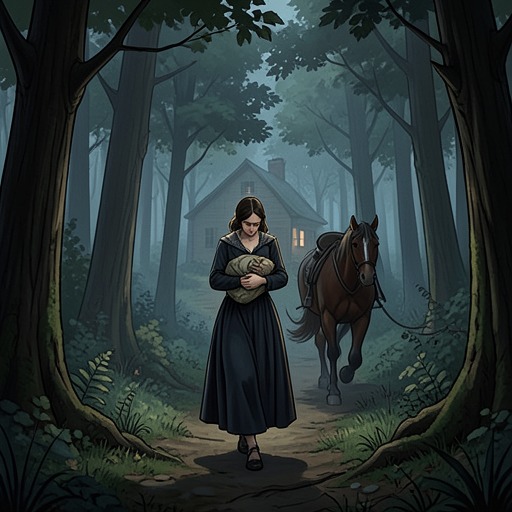
He is in town only briefly, dealing with pressing matters concerning his estate before departing for Willowbrook Hall to witness Isobel’s burial in the family crypt. Against that expectation of finality, a figure’s movement catches his attention. He watches, hoping the cloaked person will turn toward the main road, though common sense tells him the possibility he is entertaining is absurd. When the figure disappears into a bakery, he dismounts and leads Brutus to the side of the road, waiting for it to reappear.
Recognition and Narrative Significance
The bakery becomes the point around which Dominic’s uncertainty gathers. He knows that the woman he loves is supposed to be dead, yet cannot bring himself to leave without finding out who the figure is. When it emerges again, the pointed curve of a chin beneath the hood gives him a further reason to watch; he steps directly into its path, and within moments receives his answer. The evidence establishes the encounter’s decisive recognition without detailing its aftermath here.
Melton Mowbray’s crowded market thus frames a reversal in Dominic’s understanding. Ordinary commerce and animal noise continue around him while his private certainty gives way to the possibility that Isobel has returned. The town’s role is grounded in this contrast: it is at once his estate home, the place he passes through under the weight of anticipated burial, and the public setting where that expectation is challenged.